
Publish or Jobless: AI, Break-Even, and the One-Person Workshop
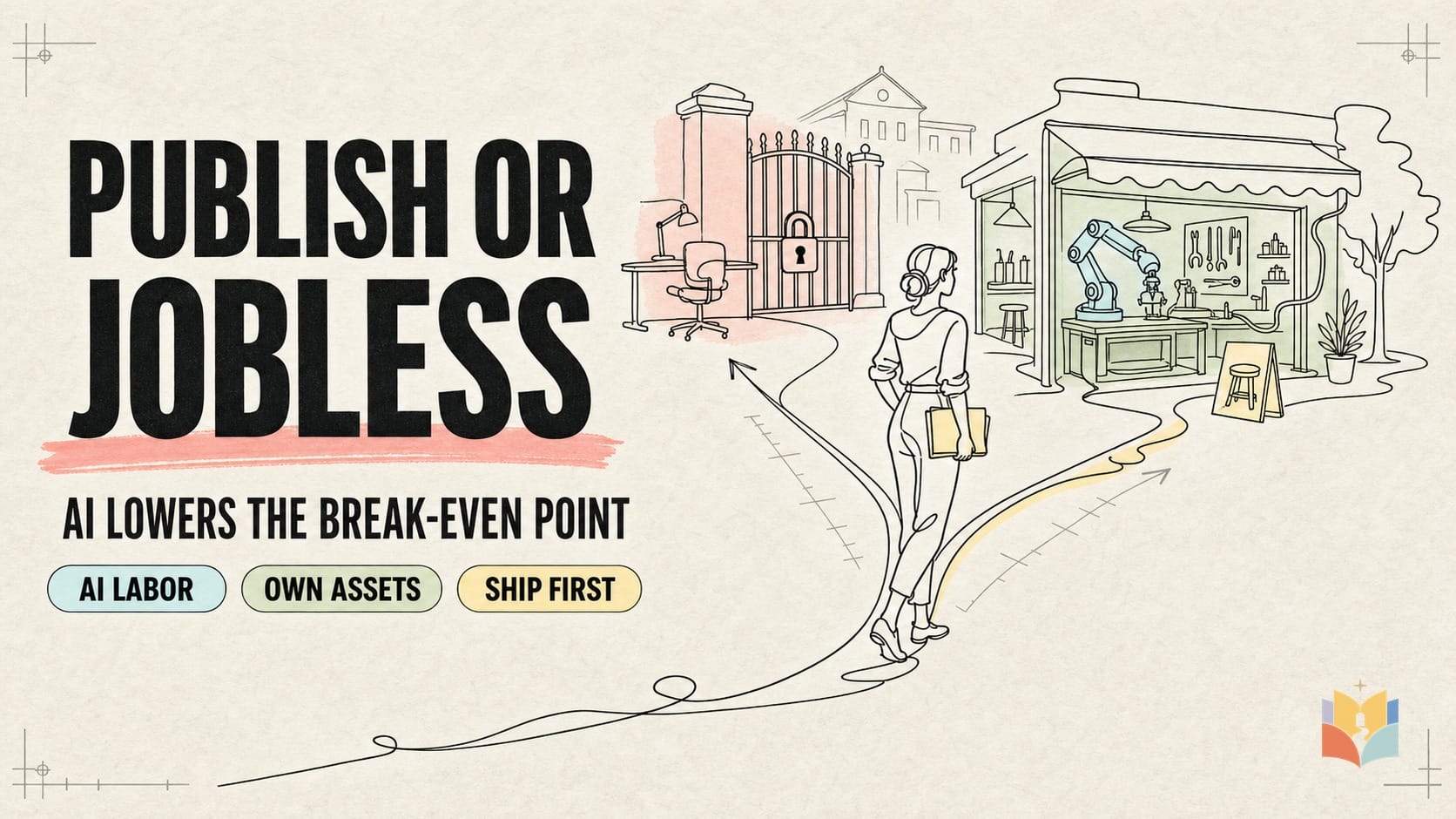
The same AI that competes with your labor can help turn private judgment into small, owned assets—if human standards and real market signals stay in charge.

Chinese version: 中文版
The same AI that competes with your labor can help turn private judgment into small, owned assets—if human standards and real market signals stay in charge.
The usual picture of AI and work places a person on one side of a desk and a machine on the other. They compete for the same tasks; one becomes more useful, and the other becomes less necessary. That picture contains a real threat, but it hides the other side of the trade. A machine that can perform part of your work for an employer can also perform part of that work for you.
AI is not only a job destroyer. It is a break-even destroyer.
When the break-even point falls
Break-even is the point where an activity finally earns enough to cover the cost of keeping it alive. A traditional product may need engineering, design, research, sales, support, and management before it earns its first dollar of profit. That makes many genuine problems economically invisible: the customers exist, but the market is too small for the company's cost structure.
AI can lower the time required for some parts of that work. In a controlled experiment, professionals using ChatGPT completed writing tasks faster and received higher quality ratings from independent evaluators. In a field study of more than five thousand customer-support agents, AI assistance increased issues resolved per hour on average, with the largest gains among less experienced workers. These studies do not prove that every task becomes cheaper or better, but they show how machine assistance can change the arithmetic of production.
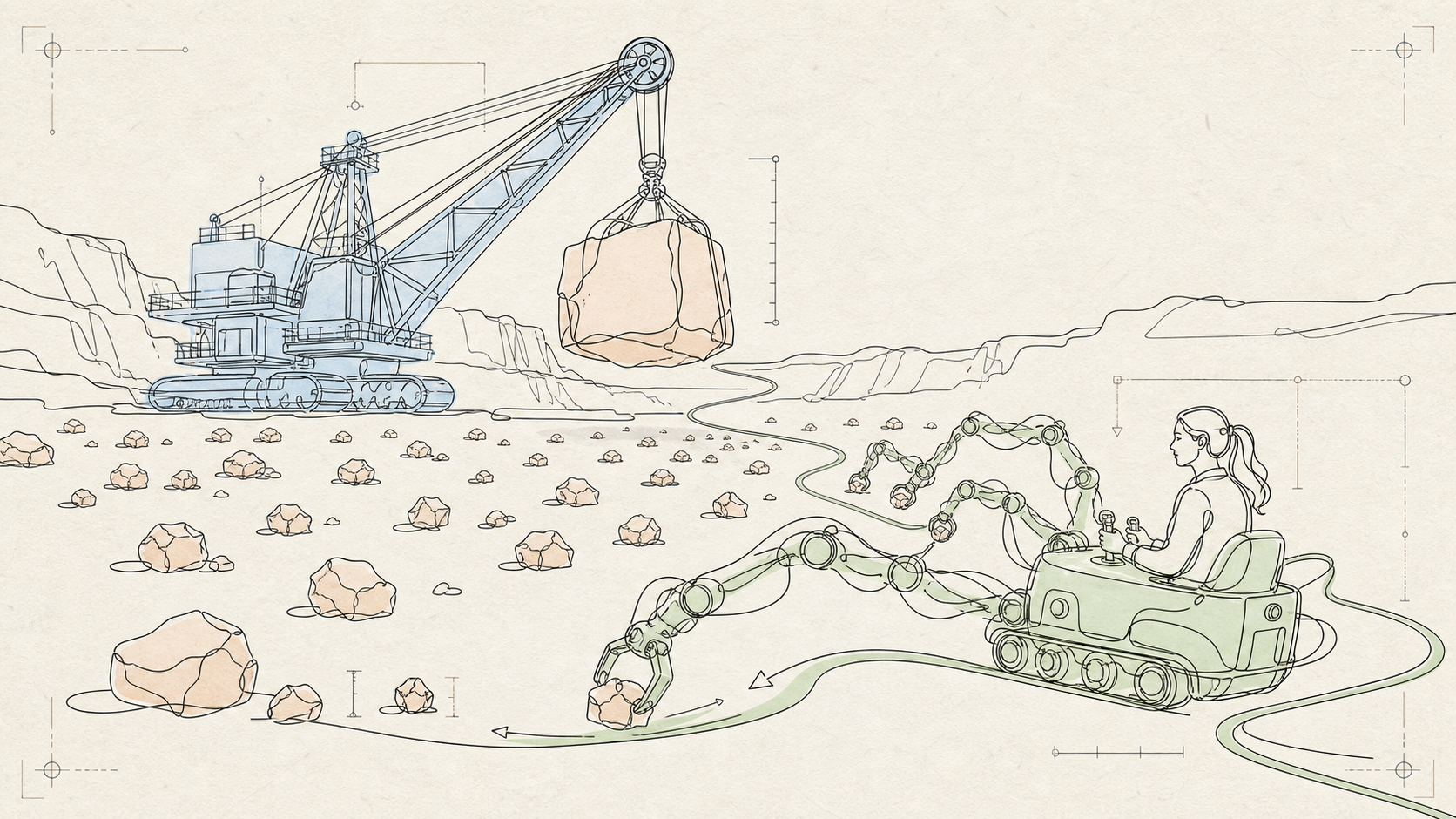
Imagine an old mining company with a machine built to lift only giant blocks of ore. Smaller pieces cover the ground, but collecting them would cost the company more than they are worth. Then one person arrives with a cart and a team of inexpensive mechanical arms. The neglected pieces suddenly become viable. The giant machine is the traditional firm. The arms are AI labor. The small pieces are narrow markets that may be too small for a department but large enough for one capable operator.
Borrowed leverage is not an owned asset
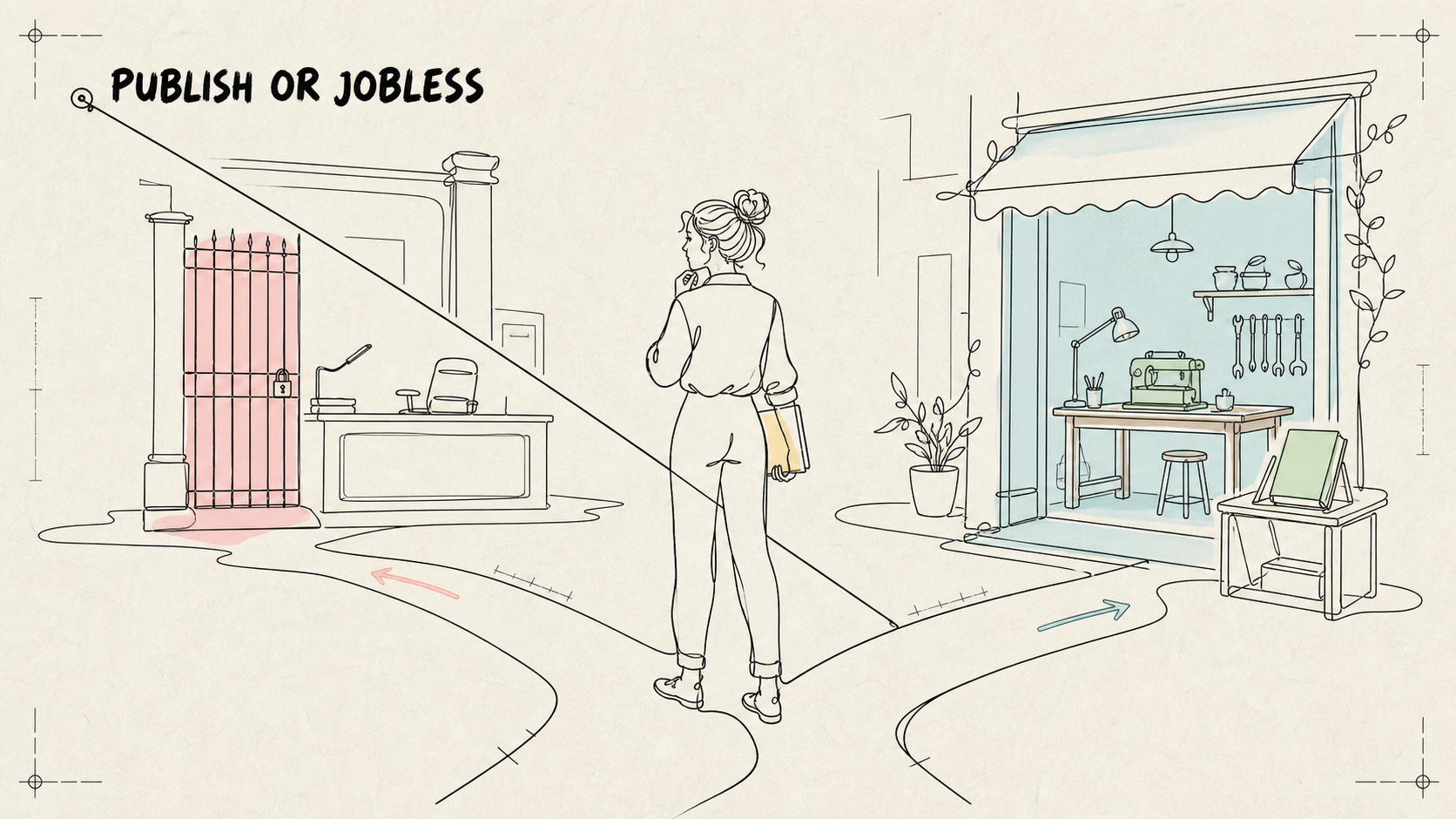
A good job provides valuable leverage: income, credibility, tools, colleagues, and a close view of real problems. But your title, budget, team, company brand, and login belong to the institution. They can disappear together. What often remains is judgment—the problems you recognize early, the standards you know how to enforce, and the taste that separates a plausible answer from a useful one.
Private judgment is difficult for a market to see. Publishing gives one repeatable piece of it a public shape. Here, publishing does not mean posting constantly or becoming famous. It means turning an idea, process, dataset, workflow, story, template, or tool into an asset that a stranger can discover, evaluate, use, buy, share, or cite.
A conventional job usually has one employer buying that slice of your labor. An owned asset can invite many possible buyers to inspect the same piece of judgment. The goal is not to package your entire career. It is to make one useful capability legible outside the institution that currently knows you.
The one-person workshop
Picture a workshop lined with small machines. One organizes customer interviews. Another drafts a prototype. Another checks links and catches broken steps. Another prepares support replies. The machines are fast and inexpensive, but not reliably right. They cannot reliably choose the customer worth serving, recognize every legal or factual risk, or decide whether the result deserves your name.
The human is not competing with the machines inside this workshop. The human decides what should exist, defines the standard, inspects the output, and accepts responsibility when it ships. AI supplies labor. The human supplies judgment.
Cheap production needs a harder gate
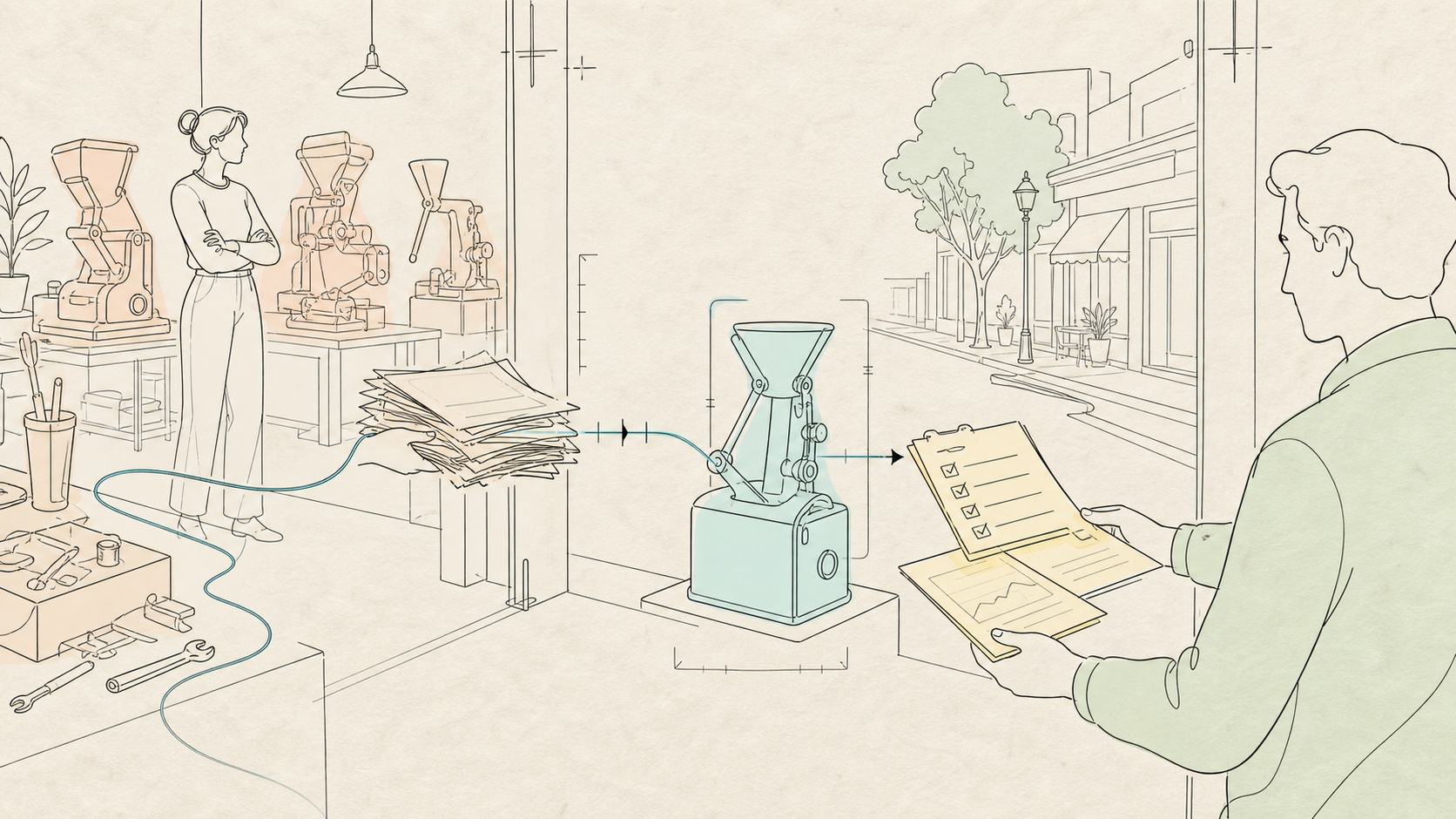
When production becomes cheap, overproduction becomes tempting. That is how machine output turns into slop: not merely because AI touched it, but because nobody exercised judgment or took responsibility before publishing it. One short-story experiment found that AI-generated ideas improved average ratings while making the resulting stories more similar. Shared machinery can increase output while pulling it toward the same safe center.
Before anything leaves the workshop, run it through a human quality gate:
- Can a real person use it end to end?
- Have its factual claims and risky assumptions been checked?
- Is it meaningfully better than the free answer a customer could generate alone?
- Does it contain a decision born from real experience or taste?
- Would you put your real name on it?
If the answer is no, the machine has produced raw material, not an asset. As generic supply expands, specificity, verification, taste, trust, and accountable human decisions become more important, not less.
Let the cold market grade the machine
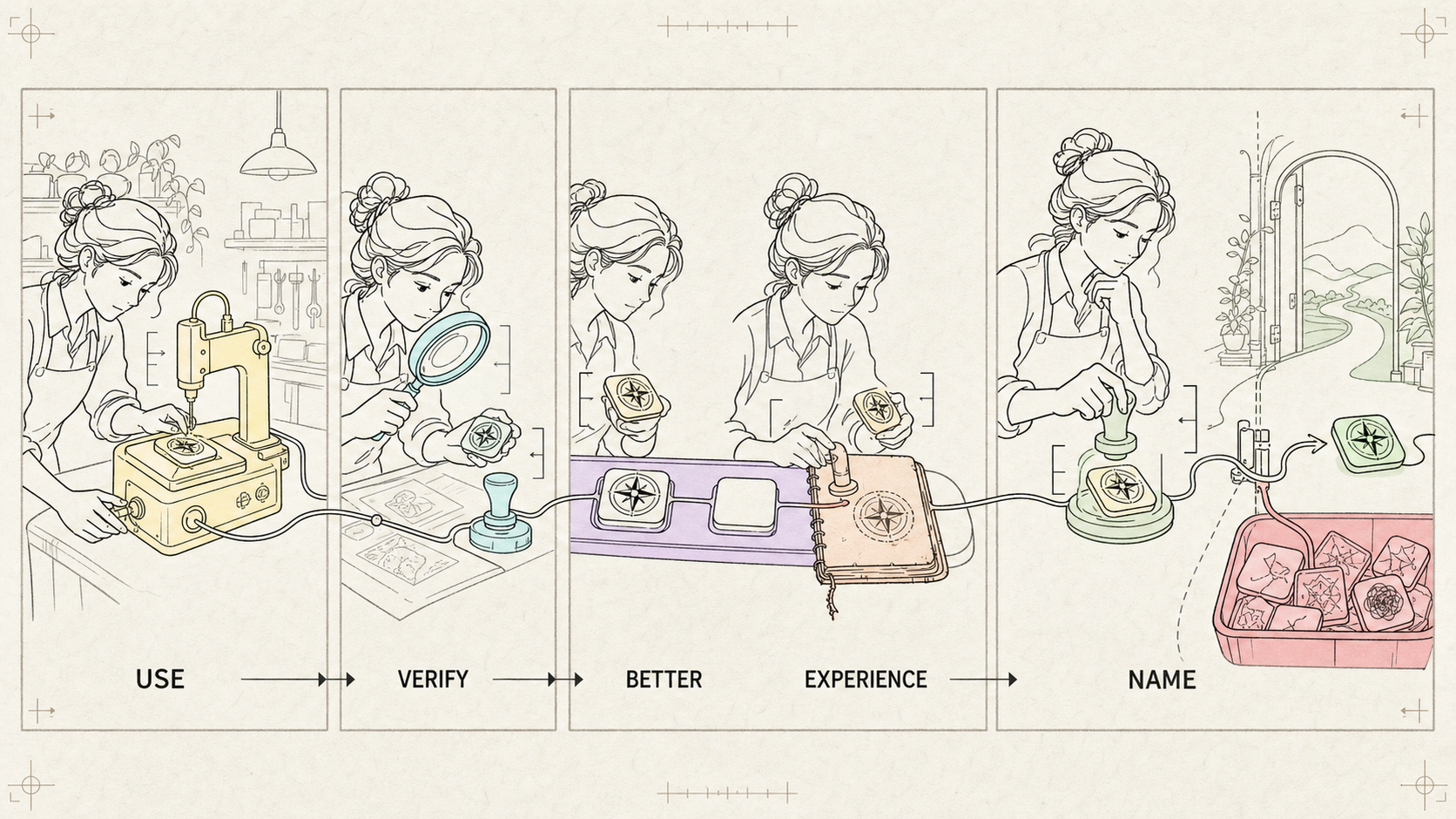
Compliments are warm signals. A return visit is colder. An email signup costs a little trust. A purchase costs money. Costlier signals usually carry stronger evidence of intent, although price, positioning, and distribution can distort any single result. The point is to move beyond private enthusiasm and let strangers interact with something complete.
Start with one narrow problem and build the smallest asset that solves it once. Put it where people already look for the answer. Give the experiment a deadline. Use the asset as a customer would, verify every claim, remove the generic parts, explain clearly who it is for, and ship before it grows into a private monument.
The first asset does not need to replace a salary. Its first job is to produce evidence. If nobody arrives, distribution failed and the asset was never truly tested. If people arrive and leave, the promise or fit may be wrong. If they use it but will not pay, the offer may be weak. These are diagnoses of one machine, not verdicts on your worth.
A portfolio, not a warehouse
If one small machine works, resist the urge to build an empire around it immediately. A second asset with a different failure mode can reduce dependence on one channel or customer type. But a portfolio is not a warehouse of abandoned experiments. Every asset should begin with a prewritten test: which signal would justify more investment, by what date, and what happens if that signal never arrives?
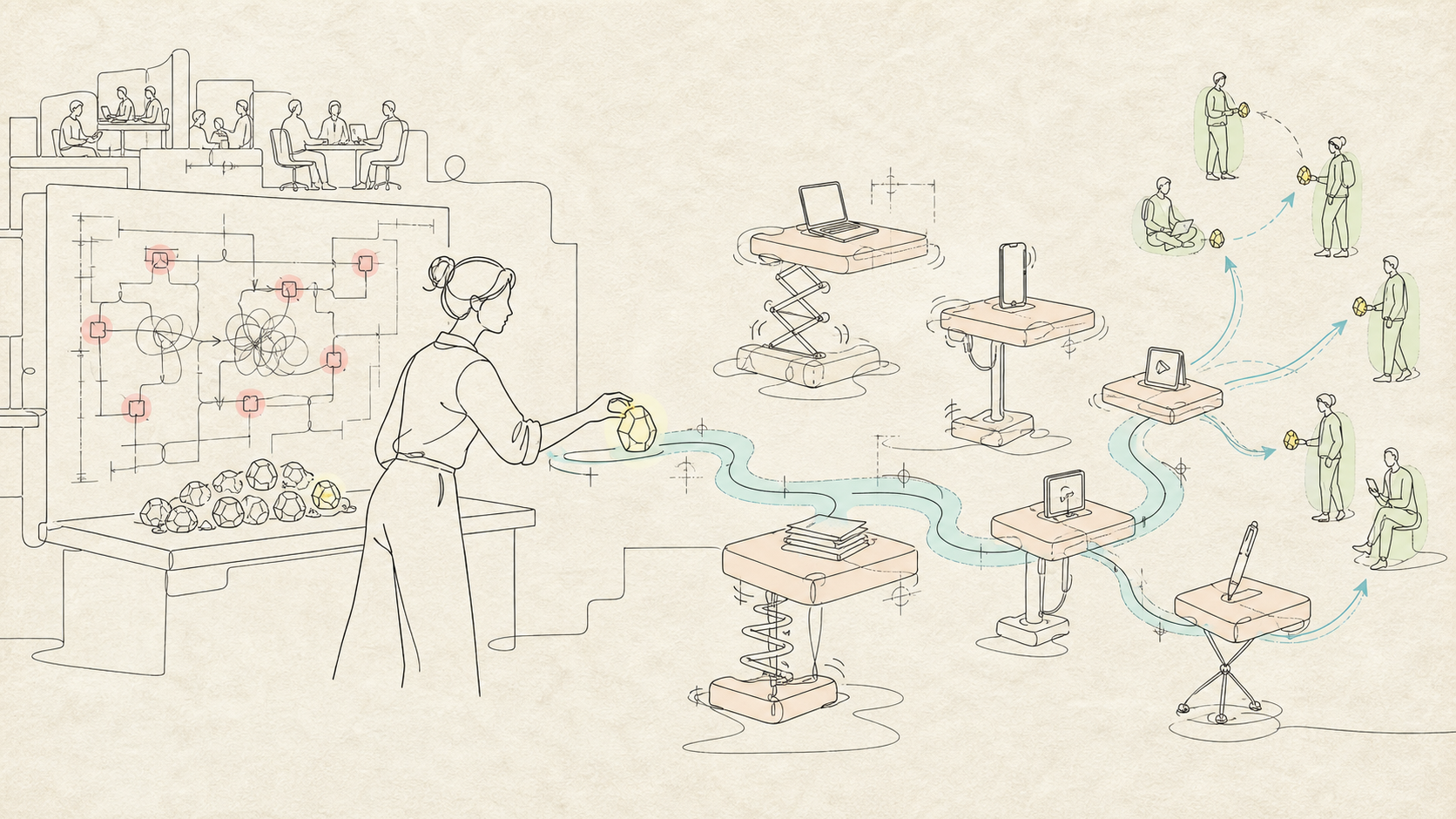
The workshop metaphor has limits. Digital assets need maintenance, distribution, customer trust, and continuing judgment. Search engines, marketplaces, payment providers, and platforms can change their rules. A portfolio reduces dependence; it does not abolish it. AI does not guarantee demand. It can make many experiments cheaper to run.
What would you make visible?
The deeper shift is not simply from employee to entrepreneur. It is from renting all your judgment to one buyer toward making some of it visible and useful to many. You can begin while employed, and your current work may be the best map of problems that large organizations consider too small, awkward, or boring to solve.
This episode and companion essay give you the central argument, operating model, and warning label. If you want the expanded case studies and market playbook, you can read more or purchase Publish or Jobless. The book is a deeper path, not a prerequisite for starting the experiment.
What repeated problem have you learned to see that your employer considers too small to fix—and what is the smallest complete asset you could publish around it?
Watch more first-principles field guides on Wiki4What, or read the essays at blog.wiki4what.com.