
Your Mind Is Not a Mirror
An ambiguous message becomes an inner trial. Explore Yogacara's eight consciousnesses and three natures through the courtroom in your head.


Chinese version: 中文版
Your manager writes, “Can we talk tomorrow?” By bedtime, your mind has assembled a case against you. The message is brief; the trial is elaborate. Who supplied all that evidence?
When the meeting arrives, she wants help with a new project. The message was real, and so was the fear. The certainty that your career was over was something you added. A Buddhist tradition called Yogacara, known in Chinese as Weishi or “consciousness only,” offers a detailed account of how experience and the sense of “me” arise together.
The courtroom will be our teaching analogy. It gives us a way to enter a difficult philosophical tradition without mistaking the example for its full argument. The account here follows the Cheng Weishi Lun, which brings together Indian commentaries on Vasubandhu’s Thirty Verses through Xuanzang’s work, emphasizing Dharmapala’s interpretation. BDK’s introduction and translation provide the historical and textual starting point.
The eight consciousnesses: who is doing what?
Begin with seeing, hearing, smelling, tasting, and bodily sensation. Yogacara distinguishes these five sensory consciousnesses as kinds of knowing. In our story, letters appear on a screen, a notification sounds, and a hand holds the phone. There are no miniature observers inside the head.
The sixth consciousness recognizes, interprets, remembers, and imagines. It turns “tomorrow” into a situation: a private meeting, a possible complaint, a threatened future. It can also compare explanations and notice that the evidence is thin. Thinking can question the story it has helped construct.

The seventh consciousness, manas, names persistent self-appropriation: in this account, it grasps the underlying stream of consciousness as a self. Our courtroom keeps stamping the file “mine.” A criticism of a project feels like a verdict on its owner. That example makes the distinction approachable, but manas means more than consciously thinking about yourself.
The eighth, alaya or storehouse consciousness, accounts for continuity and the conditioned potentials from which experience arises. These potentials are called “seeds.” A seed is a capacity to produce an effect under conditions, rather than a little memory image sitting in a drawer.
The courtroom’s familiar habits offer a limited comparison: which details catch attention, which stories sound convincing, which threats are expected. Alaya is a changing continuity, not a permanent soul or an anatomical compartment. The tradition connects it with karma and rebirth; those remain doctrinal commitments. Dan Lusthaus’s scholarly introduction explains this account and its resistance to treating consciousness as a substantial self.
The eight consciousnesses interact. They are not eight consecutive processing stations, and our imaginary courtroom has no independent judge standing outside the system.
Why the same case keeps returning
Existing tendencies help condition an experience; ongoing activity can condition further tendencies. The traditional term perfuming evokes incense leaving its scent in cloth. Rehearsing a hostile interpretation is itself an activity. Checking an interpretation is another.

That does not make every painful feeling your fault, or mean one pause erases a habit. It creates a smaller question: what am I adding now? You may not choose the initial jolt, yet you can sometimes examine the next inference or action. The classical seed account is developed in the Cheng Weishi Lun; a psychological example illustrates only part of it.
The treatise also analyzes cognition into four aspects: an appearing object, the knowing of it, cognition’s awareness of itself, and an awareness confirming that self-awareness. These are aspects of cognition, not four deliberate steps of looking inward. Its fifty-one mental factors make further distinctions among attention, feeling, intention, and other tendencies. “I feel bad” can become a more precise observation without turning the categories into buttons in the brain.
Three natures, one experience
“Consciousness only” raises a harder question than whether people interpret messages differently. Its challenge to objects existing independently of consciousness reaches into the subject–object distinction itself. The tradition’s interpretations have been debated; one office misunderstanding cannot settle those arguments.
The imagined nature concerns what is projected and grasped as independently real. “I am a failure” and “she is my enemy” are accessible examples of added judgments. The deeper target is the apparently independent self confronting an apparently independent object or threat.
The dependent nature concerns arising through conditions. In our example: a brief message, incomplete information, fatigue, past experiences, expectations, and the urge to protect a reputation. Those conditions can be investigated, and some can be changed. Recognizing them does not excuse harmful conduct.
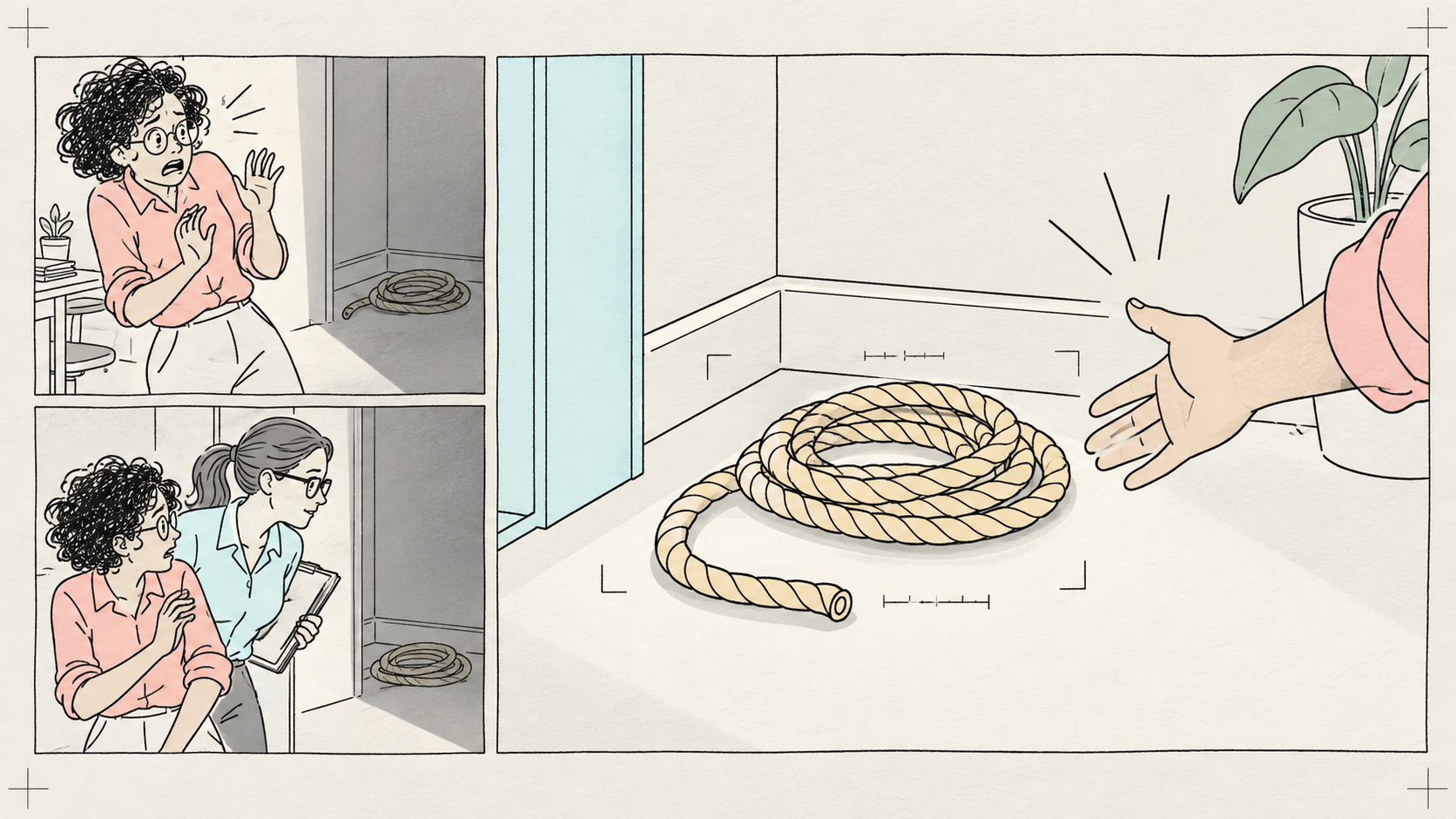
The perfected nature is the absence of the imagined separation in the dependent. It does not mean replacing bad news with good news or achieving a calmer mood. The doctrine concerns a profound nondual realization. Our example can suggest what it means to stop adding something; it cannot reproduce that realization.
These are aspects of experience, not three parallel worlds. An old teaching image makes a related point: a rope is mistaken for a snake. Fear occurs, although the feared snake is absent. Discovering the mistake changes what you take the appearance to be. The image appears in Asanga’s Summary of the Great Vehicle. For the three natures themselves, see Thirty Verses 20–22 in Francis Cook’s translation.
The corresponding teaching of three kinds of absence of self-nature requires equal care: the imagined lacks the nature attributed to it; the dependent does not originate independently; the perfected is free of the imagined nature. “Empty of what?” is a more useful question than concluding that nothing matters.
Understanding the pattern is not the end of the path
The traditional five stages are accumulation, preparation, insight, cultivation, and completion. They describe a religious path culminating in Buddhahood, including sustained cultivation after insight. A moment of clarity and a stable transformation are different achievements.
The distinction between afflictive and cognitive obstacles also resists a quick self-help translation. One concerns the afflictions binding beings to suffering; the other obstructs the full knowing sought on the bodhisattva path. They cannot be reduced to “too emotional” versus “not enough information.”
The wider aim is transformation of the basis. The traditional account associates the eight consciousnesses with accomplishing activity, discerning observation, equality, and great mirror wisdom. Clarity belongs with compassion. Our courtroom analogy points toward a life less organized around defending an imagined permanent owner, while leaving room to correct mistakes and maintain appropriate boundaries. The treatise’s final fascicles develop these path teachings.

What science and AI can help us picture
Predictive processing describes perception through predictions interacting with sensory evidence. Andy Clark’s research article offers a useful alternative to the picture of passive copying. It supplies a comparison with the construction of experience, not proof of consciousness only, karma, or liberation.
In many AI models, learned parameters influence outputs, and training changes those parameters. This can make conditioning easier to picture. But a parameter is not a karmic seed, and ordinary inference need not update weights. PyTorch’s documentation on training and inference modes helps keep the computational distinction clear.
Nor does a chatbot’s use of “I” establish experienced self-grasping. Fluent language does not settle machine consciousness. Butlin and colleagues’ work on consciousness indicators treats the question as an investigation requiring more than surface behavior.
Habit research offers another narrower comparison: repetition in recurring contexts can make responses more automatic. Wood and Rünger’s review explains that psychological account. It does not establish a karmic storehouse. A useful similarity should stay useful without becoming proof of a worldview.
A small exercise for the next ambiguous message

Write three separate lines: Observation: “My manager asked to talk tomorrow.” Interpretation: “I predict bad news.” Feeling: “I feel afraid.” You have not disproved the prediction. You have made three different claims available for inspection.
Then ask what the reaction is protecting: competence, belonging, or the picture of never disappointing anyone? List relevant conditions, including what you do not know. Choose one useful action, such as asking what to prepare for the meeting or waiting for further information.
Later, note the trigger and your response. Include moments when you checked an assumption or acted kindly, not only mistakes. This practice is an invitation to observation, without a promise of instant change or a score for spiritual attainment.
Read further
My book Weishi is a Chinese-language guide to the architecture of the Cheng Weishi Lun. It connects the eight consciousnesses, three natures, and path of transformation, separating the classical account, modern comparisons, and practical exercises. See reading and purchase details for the Chinese-language book.
When the courtroom opens again, try asking: what appeared, what did I add, and what am I taking to be me? Which of those questions is easiest to forget?
Watch more first-principles field guides on Wiki4What, or read the essays at blog.wiki4what.com.